
Mary Cumming’s Letters Home to Lisburn from America (1811–1815)
 | MARYCUMMING’S LETTERSHOME fromAmerica Editedby Jimmy Irvine � Jimmy Irvine1982 [contact details archived] ALL RIGHTSRESERVED |
| Mary Cumming’s father was the Rev. Andrew Craig, minister of Lisburn Presbyterian Church from 1782-1824. The family lived at Strawberry Hill just outside the town. In 1811, when only twenty, Mary married and emigrated to America with William Cumming of Armagh, a cotton merchant in Petersburg, Virginia, who acted as agent for a Baltimore trading house founded by his kinsman Alexander Brown, formerly of Ballymena.Mary’s letters home described the horrors of the Atlantic crossing to New York, the delights of the journey south along the eastern seaboard by steamboat or coach through brilliant autumn forests, the welcome by her husband’s negro household – she could not bear to call them slaves, the whirl of social life, the spacious lifestyle adopted by the many Irish immigrants she met – some of them friends of her father before the ’98 and the fervour created by the war of 1812 against the British. The letters reveal an emotional conflict between Mary’s devotion to her husband and an aching homesickness, only mollified by his promise to return to Ireland within a few years. However, a shadow fell across Mary’s life. Her baby died, and she became desperately ill. When war broke out with Britain her hopes of an early return home were dashed. In 1814 William was eventually able to plan their return for the following spring; but Mary knew she would not live to see it, and on her death-bed wrote farewell letters which make poignant reading. |
| 1. | Genealogical Tables | |
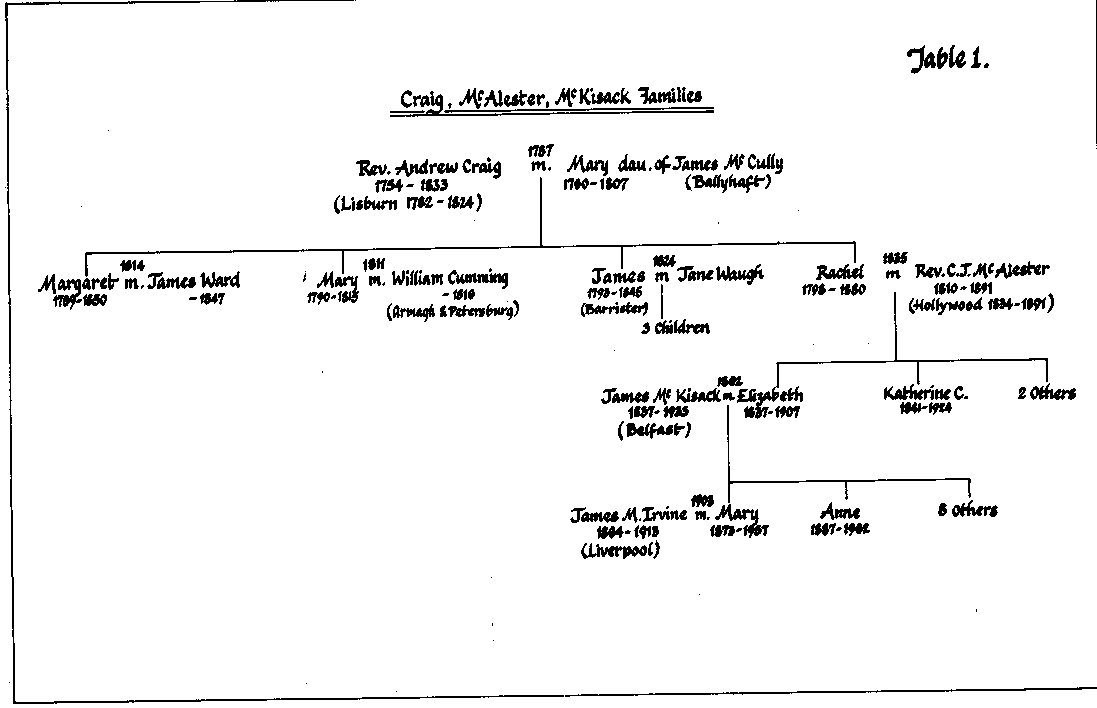
| 1. | Craig, McAlester and McKisack Families | |
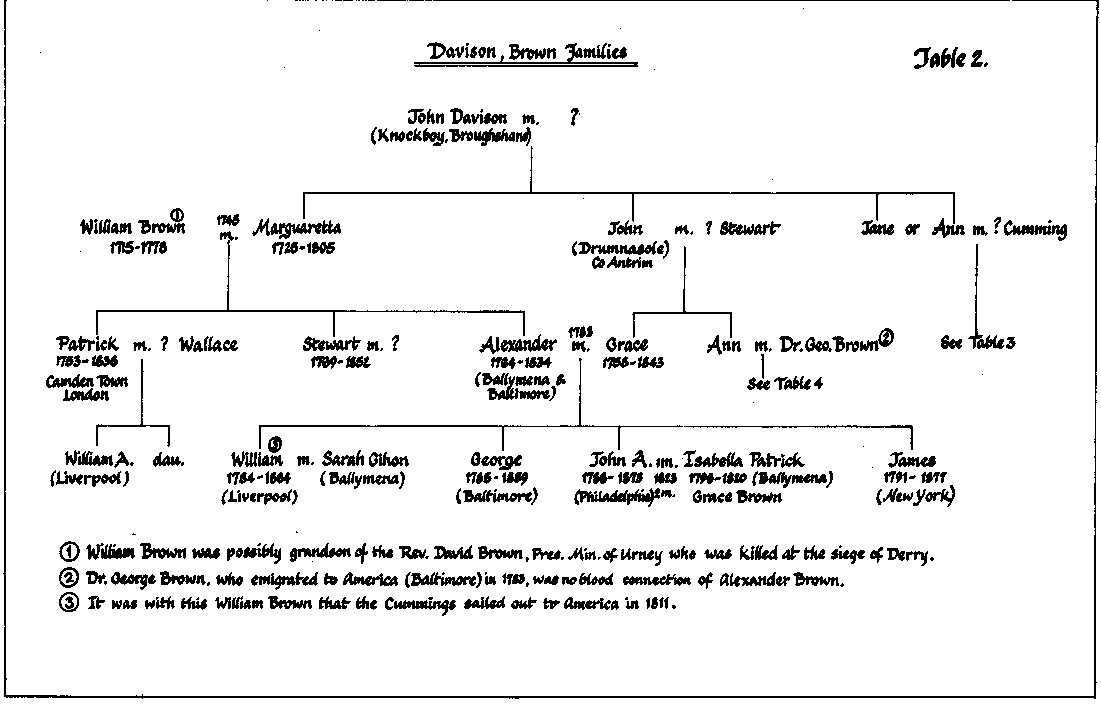
| 2. | Davidson andBrown Families. | |
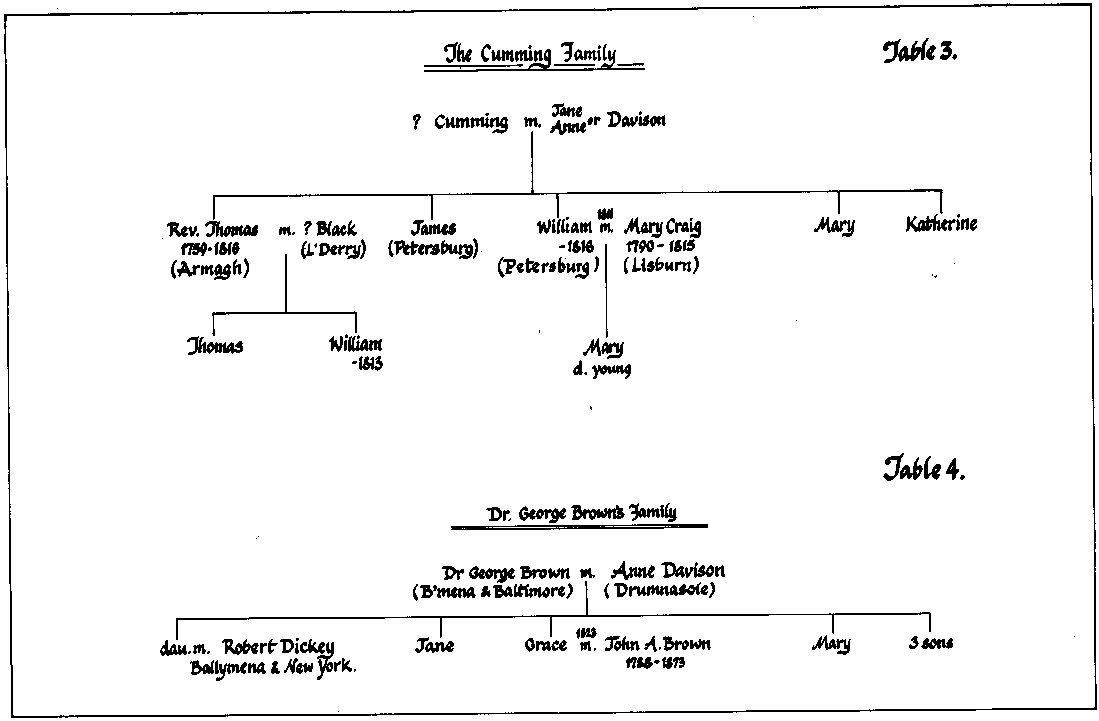
| 3. | The CummingFamily. | |
| 4. | Dr. GeorgeBrown’s Family. with Cumming’s family Tree | |
| 2. | The Browns ofBrown, Shipley & Co | |
| 3. | Note on thesiting of Petersburg, Virginia. | |
| 4. | Elegy byHenderson Wightman. | |
| 5. | The “Mary Cumming.” | |
| Bibliography | ||
Coloured Plates
| 1. | Mary Cumming, by unknown American artist; IS” x 15″, pastelportrait, 1812. |
| 2. | The Rev. Andrew Craig, by ThomasRobinson, 37″ x 29″, portrait in oil, approx. 1800. |
| 3. | Strawberry Hill. by W. J. Carey, 14″ x 8″, water colour, 1934. |
| 4. | Lisburn from Strawberry Hill, by W. J.Carey, 14″ x 8″, water colour, 1934. |
Blackand White Plates | |
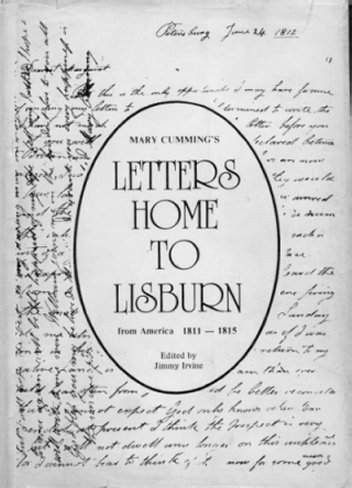
| 5. | Facsimile extract from Mary Cumming’s letter dated Petersburg, June 24, 1812 |
| 6. | Map of the Cumming’s Journey from NewYork to Petersburg. |
| 7. | Andrew Craig’s grandfather clock. dial face, inscribed “John Heron,Lisburn, No. 64.” |
| 8. | Sketch of Glasgow College, by AndrewCraig. circa 1790 from the Ulster Journal of Archaeology. second series, Vol. XIV. |
| 9. | The Musical Glasses,purchased by Andrew Craigin 1812. |
| 10. | Sampler, by Rachel Craig. I I” x 8″. worked when she was eightyears old. |
| 11. | Rachel Craig, silhouette 3�� x 2�� 1833 shortly before her marriageto the Rev. C. .I. McAlester. |
| 12. | The Rev. Charles James McAlester, by Frank McKelvey, 27″ x 22″portrait in oil from a photograph. |
| 13. | Mrs. Elizabeth McKisack, by R. S. Praeger, 9″ x 7″, pastelportrait, 1908. |
| 14. | Alexander Brown, from “A Hundred Years of Merchant Banking.” |
| 15. | Mrs. Alexander Brown, from “Heir ofAdventure.” |
| 16. | The Brown’s old family home in Ballymena,from “A Hundred Years of Merchant Banking.” |
| 17. | Alexander Brown and his Four Sons, from “Heir of Adventure.” |
Some years before the idea of publishing these lettersoccurred to me, Mrs. Margaret Garner of Helen’s Bay, completed an exhaustiveresearch based on their typescript copies in the Public Records Office ofNorthern Ireland. She also visited Petersburg, Virginia, and discovered theremuch local detail which at once confirmed and enlarged upon her previous work.Without hesitation she kindly gave me the use of all her material, from whichmuch of the information contained in my Notes is directly taken. I sincerelythank her for her generosity.
I thank Mr. Brian Trainor for initiating the restoration of the Letters and Mr.Harry Baillie for so skilfully executing their repair that it is now possible tohandle and inspect them without fear of doing damage.
And I wish to thank Mr. J. R. Bone who, on behalf of Brown, Shipley and Co.Ltd., gave permission to reproduce two illustrations from Aytoun Ellis’s book”Heir of Adventure.” Also Arno Press Inc. for permission to reproducetwo illustrations from their reprint (1978) of “A Hundred Years of MerchantBanking” by John Crosby Brown.
Also Lisburn Museum and the curator Mr. Brian Mackey for assistance withphotographic work.
Finally I thank Mrs. Nora Hanna of Holywood and various members of my family fortheir many helpful suggestions regarding the presentation of this fascinatingcollection of letters.
The collection consists of some thirty letters written home from America between1811 and 1815 by the newly married Mary Cumming, most of them to her sisterMargaret Craig. Their father, the Rev. Andrew Craig, was Presbyterian ministerin Lisburn, Co. Antrim, from 1782 till 1824. At first he lodged with JohnWightman in Lisburn, but in 1785 he took up a bachelor’s residence at StrawberryHill, a property just outside the town. Two years later he married Mary,daughter of James and Margaret McCully, of Ballyhaft near Newtownards. They hadsix children, of whom Margaret, Mary, James and Rachel reached maturity. Aftertheir mother’s untimely death in 1807, the children grew up at Strawberry Hillas a devoted and closely-knit family, with Margaret filling in the vacant gap asbest she could.
Not yet twenty-one, Mary was the first to leave the familyfold. On 8th August, 1811, she married William Cumming, formerly of Armagh, butthen of Petersburg, Virginia. The service was conducted at Strawberry Hill byWilliam’s elder brother, the Rev. Thomas Cumming. William and his youngerbrother, James, had already emigrated to Petersburg where they acted as agentsfor their cousin Alex Brown of Baltimore. Earlier in the year, William had comehome to visit his parents in Armagh, and it was immediately prior to his returnto Petersburg that the wedding took place.
By the end of August the newly married couple were inLiverpool awaiting passage to New York. They eventually sailed on 28th Septemberaboard the “Lydia,” with William Brown and his wife and baby daughteras their unexpected travel companions. William Brown was the eldest son of theabove Alex Brown and he later founded the famous banking house of Brown, Shipleyand Co. of Liverpool. The voyage took forty-one days and is vividly depicted inMary’s letter of 8 November, 1811.
Subsequent letters describe her new home, her black people- Mary could not bear to call them slaves, and her social life in Petersburg.Many of her friends there were of Co. Antrim origin, and there were frequentenquiries for relatives and friends left behind in the home country. The happyarrival of a baby daughter in May 1812, and her sad death four months later makefirst joyous and then poignant reading. There are references to the war withAmerica in 1812 which disrupted letters to and from home and eventually delayedMary’s longed-for return to Ireland until it was too late.
Petersburg lay in the fever infested North American east coastal plain, andMary’s health began to suffer. It became clear to her that she was going to die.Her farewell letters to her sisters and to her absent husband are moving in theextreme. She died in April 1815, not yet four years wed. William immediatelysailed back alone to Ireland and visited Mary’s father and sisters at StrawberryHill. Within months of his return to Petersburg he too died, probably struckdown by the same fatal fever that had claimed his wife.
Mary’s letters reveal a deep love for her native Ireland, for her childhood homeand for her whole family. She counselled her younger brother James against toohastily entering into matrimony and on no account against their father’s wishes.She inquired tenderly after the welfare of her younger sister Rachel, and forher childhood friends. The few letters to her father display a rare warmth offifial affection. With her dear William she had been intensely happy, and to himshe was always devoted and loyal. “If I ever offended you,” she wrote,”forgive me for it; but alas, why need I say so? We were almost too happywith one another.” Finally, as far as she was able, Mary gratefullyacknowledged all the joys and riches of her short life to be the undeservedgifts of her Maker.
After Mary Cumming’s death, the letters she had sent home to Lisburn weregathered together and loosely folded into a soft paper cover. Only the twowritten on her death-bed to her sisters and her husband were held back by theirrecipients, and even then copies of these were inserted.
On their father’s death in1833, Mary’s younger sister Rachel came into possession of the furniture andcontents of Strawberry Hill, including the Letters. Two years later Rachelmarried the Rev. C. J. McAlester of Holywood, Co. Down, and took with her totheir newly-built manse in Croft Road much of the old family furniture. There itremained till her husband’s death in 1891. Her younger unmarried daughter, MissKatherine Cumming McAlester, then took up residence in a neighbouring house, towhich such pieces as there was room for were transferred. It was Miss McAlesterwho had the letters transcribed and the typescript sheets bound into book form.On her death in 1924 she left all to her niece, Miss Anne McKisack of MountPleasant, Belfast. She in turn made the typescript available to the PublicRecords Office of Northern Ireland where they are currently catalogued underReference No. T 2757.
Miss McKisack died in 1962, leaving her residence and itscontents to her nephew, the editor of the present publication. However, it wasnot till six years later that he first set eyes on the originals. To read theircrumpled pages and discover an actual lock of Mary’s hair wrapped in a scrap offaded linen and secured to the back of the cover by a rusty old pin was a movingexperience.
The Letters’ deteriorating condition was self evident. Tohandle their trounced and wrinkled pages was painful, in that doing sounavoidably caused them further damage. When Mr. Brian Trainor of the PublicRecords Office of Northern Ireland, saw their condition he very kindly offeredto have them repaired and restored. This was done by first making good any tornor defective pages. Each was then soaked and covered, back and front, by a layerof very fine silk mesh, so fine that, though the paper within was completelyenveloped, what was written on it could still easily be read. The restoredsheets were then dried and pressed, and finally bound between hard boards. Andso it has been possible to study the Letters at leisure and now make them morewidely available.
Table of Contents
About this Publication
- Author
- Mary Cumming (Edited by Jimmy Irvine)
- Archival Theme
- Commercial & Industrial Heritage
- Publisher
- Impact-Amergin, Coleraine

Preserving the Books, Journals & Literature of Lisburn & the Lagan Valley
Lisburn.com is Northern Ireland’s first community web archive, chronicling our townlands, local businesses, cultural heritage, and shared history for 30 years (1996–2026). Freely accessible to all.