

by Paul Cormacain
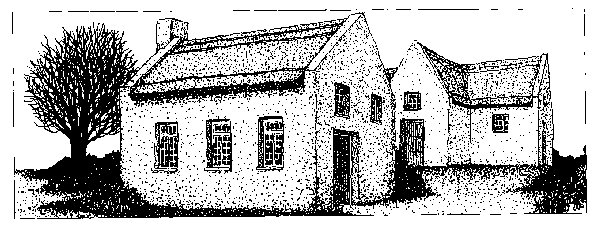
A JOURNEY to Nendrum in north Down put us in touch with some of the folk who went before us.
Here, one could look out over a thousand years of history, marvel at it, be impressed by it, and wonder at the progress of humankind since then. After absorbing the atmosphere, the serenity and the history, we had to go and look at the birds and the flowers.
We discovered lesser periwinkles in full bloom, a lovely flower, a colourful flower, and a blow in. This flower was probably introduced into Britain from Europe, and its presence was recorded in the West Country in the middle of the 16th century. I have not been able to find out when it crossed the Irish Sea.
The bible of British Flora, Keble Martin’s book, says that in Britain the flower is rarely found. It also says that it flowers in the autumn, and in March to May. These plants at Nendrum seem to be illiterate, or else they just never bothered to read Keble Martin, for they were in full-flower at the end of December.
The lesser periwinkle, Vinca minor, comes with a good line in curative properties. Crowns of the flowers used to be worn by folk who were about to be executed in England, (a revolting custom), on the grounds that the evergreen plant was regarded as symbol of immortality. So anyone about to be executed can nip down to Nendrum! The lesser periwinkle can also be used as a medical aid.
A married couple could eat it together because Venus owns the flower, and the eating can cause “loving between them”. Great if you want to have children.
So we checked the Royal Horticultural Society book, and found that the Vinca minor bears white flowers from mid-spring to early summer. At Nendrum, the flowers are a delightful blue.
Another interesting aspect of the periwinkle is for Christians only. If you are a Christian and you have a nose-bleed problem, tie a garland of the flowers around your neck. “It has an excellent virtue to staunch bleeding in the nose in Christians”. Perhaps I should get away from the lesser periwinkle, Vinca minor, and write about the birds.
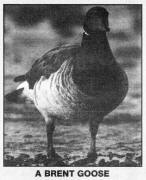
James Orr, of Castle Espie fame, tells me that they had 20,000 Irish brent geese passing through this year. You all know, of course, that the Irish brent is bred on Bathurst Island in Arctic Canada. What, did I never tell you ? Every bird goes to Iceland and Greenland , then goes to Castle Espie to see James, then start to disperse for the winter. We saw some rent off Mahee Island. We did not see any at Espie itself, but a small flock at Mahee was sufficient. These birds are magical, and every time you see them you cannot fail to recognise their huge flight and good taste. They were in company with some shelduck, large colourful birds which are a delight to the eye.
When you think duck, you visualise mallard with the male brightly coloured and the female dull and dowdy. The thinking is that the female is good for sitting on eggs, good for bringing up the kids, good or remaining inconspicuous, while the male is good for nothing. The shelduck have it sorted out, with male and female almost identical apart from a knob at the base of the bill. So they are both brightly coloured, so both parents incubate? No, absolutely not. Only the female incubates.
The female lines the nest, usually in an old rabbit burrow or such-like, and then looks after the young when they leave the nest. So much for being beautiful, but what about some equality
Nearby, on a sandbank, a flock of knots was feeding and resting. This was considered a mysterious bird in the past. It came from – well no one knew where it came from. It returned to – again, no one knew where. Thanks to some research, we now know that the bird breeds far north of the Arctic Circle. Then it starts a mighty migration, moving through a southern route as far south as Patagonia. Huge numbers move to south Africa, others go to New Zealand and Australia. Some just go to Britain and Ireland, like the ones we saw. Well, even that is a mighty migration. Its hard work watching such mighty travellers!
COMING EVENTS
Saturday, January 22: animal and human winter survival training, courtesy of Wildlife Trust, at Greenmount Agricultural College, phone [contact details archived].
Sunday, January 23: At Colin Glen Trust, the Birds of Colin Glen, 1000, details from [contact details archived].
Wednesday, January 26: Irish Garden Pant Society, jointly with RHS and Ulster Museum, hosting New Year Lecture, and more from [contact details archived], ask for Catherine.
Thursday, January 27: Oxford Island hosts a talk, photographic exhibition, and display on traditional boat building and fishing in the Lough Neagh area, contact [contact details archived].
Saturday, January 29: Bird Ringing at the Wildlife Trust in Crossgar, with North Down Ringing Group.
Ulster Star
07/01/2005

Preserving the Environment & Outdoors of Lisburn & the Lagan Valley
Lisburn.com is Northern Ireland’s first community web archive, chronicling our townlands, local businesses, cultural heritage, and shared history for 30 years (1996–2026). Freely accessible to all.

Leave a Reply